Empowering Nurses: Strategies for Preventing Burnout and Boosting Mental Health
The stress endured by bedside professionals is well known. Still, practical solutions can feel scarce. Below, find actionable strategies for preventing burnout, the accumulation of stress over time. Listen to the full on-demand webinar to earn one contact hour.
Stress is an inevitable aspect of medical careers. However, a growing number of nurses and other bedside professionals (CNAs, technicians, OT and PT professionals, residents, and physicians, to name a few) are experiencing stress’s more extreme counterpart: Burnout. These findings illustrate the sobering reality:
- In an American Nurses Association (ANA) study of 10,000 nurses, 30% had symptoms of depression, 50% felt overwhelmed, and more than 70% had sleeping disorders
- In a 2020 ANA survey, almost two-thirds of nurses – 62% – said they’d experienced burnout. Rates were highest among younger nurses, with 69% under age 25 having experienced burnout symptoms.
- Per Centers for Disease Control and Prevention (CDC) federal statistics, healthcare workers experienced more mental health declines between 2018 and 2022 than workers in any other sector.
- The American Nurses Foundation found that 66% of nurses under age 35 report feeling anxious.
In short, there’s no question that pronounced stress levels are infiltrating healthcare – a frightening and heartbreaking reality for the individuals who make up America’s most trusted profession[1]. So what exactly is burnout, and why is it spiking?
STRESS VS. BURNOUT
First identified in the 1970s[2], burnout is a pervasive state of exhaustion resulting from excessive job demands. Burnout is often used interchangeably with stress. However, stress and burnout are physiologically quite different:
Stress is the body’s response to pressure or demands. It is short-term and primarily presents physically, usually via a burst of energy, rapid heartbeat, and hyper-alertness. Stress sometimes produces positive caregiving benefits, like quick response times and the ability to remain attentive over long stretches.
Burnout, meanwhile, is a state of mental, physical, and emotional exhaustion resulting from the accumulation of prolonged, excessive, and/or untreated stress. Unlike stress, burnout can be prevented – and should be. Relative to stress, it has much higher risks for mental health in particular, as shown in this diagram comparing the two:
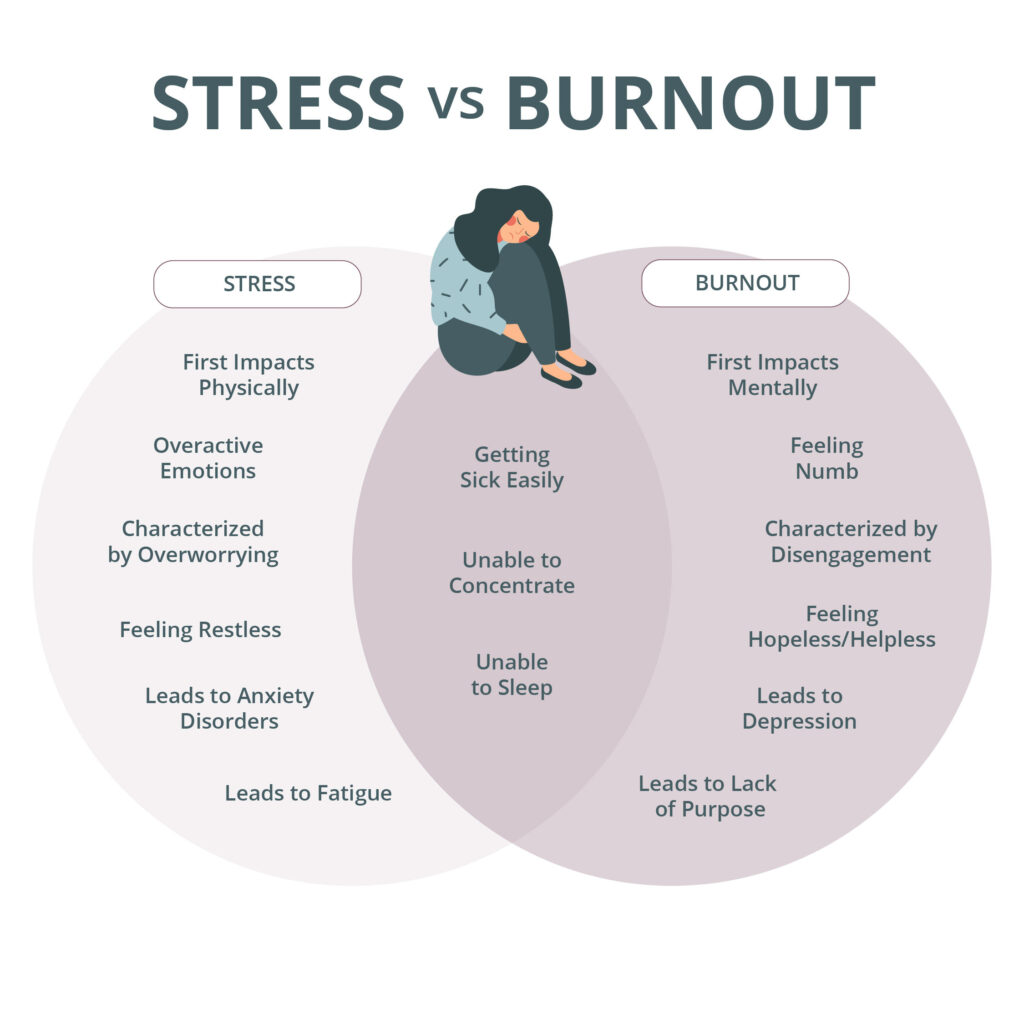
Of note: Burnout is not formally identified as a mental disorder[3]. However, the World Health Organization classifies it as an occupational syndrome under the category of “factors influencing health status,” meaning it can carry these health implications for those enduring it:
- Mental and physical exhaustion
- Mental distancing from a job
- Cynicism
- Poor job performance
- Fatigue
- Constant dread
- Loss of appetite and appetite changes
- Poor sleep/sleep disturbance
- Anxiety
- Depression
- Illness (aches, pains, headaches, general physical injury)
Burnout’s impact on careers and on healthcare organizations is equally loaded. For clinicians, burnout can cause diminished job performance and increased errors, putting licenses and reputations on the line. After all, as the old saying goes, you can’t pour from an empty cup, meaning if clinicians aren’t healthy, they can’t do their job, putting patients at risk, too. This sobering reality fuels burnout’s repercussions for organizations:
- Financial strains, largely from medical errors or diminished patient care resulting in repeat admissions, lawsuits, waning business, and the cost of health-related nurse leaves
- High turnover rates
- Staffing shortages
These risks are particularly daunting given healthcare is already plagued by shortages and high turnover – current and anticipated. Consider the statistics:
- More than 600,000 nurses intend to leave the profession by 2027 (Martin, Kaminski-Oxturk, O’Hara, & Smiley, 2023).
- The turnover rate for nursing was 18.4% in 2023, with the average cost of turnover for staff members coming in around $56,000. In the past five years, nurses in stepdown units, emergency rooms, and telemetry were most likely to put in notice, with a cumulative turnover rate between 112% and 119%. Put another way, these departments turn over their entire staff in less than four and a half years.
- The Health Workforce Analysis published by the Health Resources and Services Administration in 2022 stated that federal authorities projected a shortage of 78,610 full-time RNs in 2025 and a shortage of 63,720 full-time RNs in 2030[4].
In sum, there are near-endless reasons to prevent burnout among healthcare workers. It starts with a stronger understanding of what causes it.
CAUSES OF BURNOUT
Factors contributing to burnout are as follows:
- High patient-to-nurse ratios – most nurses agree that ratios are a driving factor, if not the driving factor, behind burnout, and a reason why nurses are leaving (or choosing not to enter) the field. Consider what’s at stake: According to a 2002 Journal of American Medical Association article, hospitals with 1:8 nurse-to-patient ratios experience five more deaths per 1000 patients than hospitals with 1:4 ratios. Chances of a patient dying increase by seven percent for each additional patient for whom a nurse is responsible. Even if they don’t know these exact statistics, nurses feel the risk at hand when they’re responsible for numerous patients.
- Pressure of quick decision-making – the degree of executive decision-making required by clinicians exceeds any other industry in terms of volume and risk.
- Long and irregular hours; mandated overtime – it’s the standard in nursing; still, 12 hours is a long time to be engaged with patients and away from home. Beyond long shifts, most nurses (especially early career nurses) also work some holidays, weekends, and/or overtime.
- Patients and patient family-induced stress – nurses interact with individuals experiencing some of the worst days of their lives. Their work involves high emotions, sometimes taken out on caregivers – occasionally even in the form of assault, which is on the rise in healthcare settings[5].
- Emotional strain – all units, but especially higher risk units (PICU, pediatric ER, ER, ICU), dole out micro-doses of trauma every day via grave events including death and dying. Healthcare workers are tasked with not only managing these dire scenarios, but communicating them to a patient’s loved ones.
- Risk of exposure – the possibility of needle sticks and contagious pathogen exposure looms over healthcare staff. Many perpetually wonder: Am I bringing something home to my family? Will I get sick, impacting my ability to work?
- Lack of support or resources – nurses aren’t always given the necessary resources needed to do their job, or they have the resources but don’t know it – another problem in many clinical settings.
- Administrative workload – healthcare workers are increasingly responsible for non-nursing responsibilities: answering phones and doors, janitorial tasks, enforcing visitor policies.
- Physical demands – patients are physically getting bigger; at the same time, staff sizes are decreasing.
STRATEGIES FOR PREVENTING AND MANAGING BURNOUT
Perhaps most frightening about burnout is the thought of clinicians enduring it while administering care to patients. Luckily, clinicians have a number of strategies available for improving their mental and physical health in the quest to prevent burnout. Here are some mental health strategies, resources, and tools:
- Stress management techniques – hobbies, mindfulness, and meditation are all proven to boost mental health; figure out what works for you and incorporate it into practice at home and at work.
- Self-care apps – smartphone apps, some specifically designed for professional caregivers, offer resources, reminders, tracking tools, and more spanning everything from meditation to mindful eating. Some popular options include Fifth Window (designed for nurses, by nurses), Nursewell, Headspace, Calm, Aloe Bud, 7 Cups. Dare, and Reflectly.
- Building resilience – what lifts you up at end of long day? Identify and practice positive habits that work for you.
Seek professional help – if the resources and choices above aren’t cutting it and you’re no longer thriving, seek out a professional. This can be a therapist, counselor, or professional organization. Free options include COVID Calm, Frontline Therapy Network, and the Emotional PPE Project; others that can help include the National Alliance on Mental Illness, Healthy Nurse, Healthy Nation (an initiative of the American Nurses Association Enterprise), Well Being Initiative, and employee assistance programs (EAPs) provided by some employers.
Physical health strategies, resources, and tools:
- Basic self-care – theoretically simple but often overlooked, these are the same things we preach to patients: Exercise, sleep, and good nutrition.
- Use of/advocacy for caregiver assisted tools – bedside care can be physically taxing; it’s critical that healthcare providers procure right-fit tools for safe patient handling and mobility and encourage nurses and staff to use them. In a time crunch, it can be tempting to move a patient yourself instead of using a sling or air transfer device that makes it easier; however, the risk of injury is never worth the time saved.
- Basic injury prevention practices – don’t take shortcuts. Protocols are in place for reason. They need to be followed, and organizations need to enforce them.
Mental health hurdles among employees put the onus on healthcare organizations, too. Here are ways organizations can help protect against burnout:
- Adequate staffing – provide nurse-to-patient ratios as close to 1:4 as possible.
- Standardized workplace debriefing – debriefing with coworkers is healthier than playing events over and over in your head; however, there’s a drastic difference between casual discussion in the breakroom and an organized debrief designed to produce actionable reflection. Healthcare organizations are wise to standardize debriefs: that is, designated, HIPPA-protected conversations in which staff members reflect on a care case, constructively discussing what worked, what didn’t, and areas for improvement.
- Provide mental health resources and support.
- Encourage work-life balance.
- Offer professional development training.
- Promote a Healthy Work Environment – healthcare facilities are wise to uphold the American Association of Colleges and Nursing (AACN) Healthy Work Environment Standards. The Healthy Work Environment Assessment Tool (HWEAT) is a great place to start. HWEAT takes less than 15 minutes to complete. Employees respond anonymously to questions designed to assess workplace norms; results can be used to promote discussion and make improvements. Workplaces that use HWEAT results to make improvements go on to enjoy higher nurse wellbeing scores, greater job satisfaction, less moral distress, less turnover, and higher quality of care as reported by patients.
Our society relies on nurses and other bedside clinicians to provide quality care. If you or nurses in your workplace have mental health concerns, or are experiencing levels of stress that are leading to burnout, don’t hesitate to address it. If you or someone you know is experiencing a mental health crisis, help can be reached 24 hours a day, 7 days a week simply by dialing or texting 988.
Want to discover more about Healthy Work Environment Standards and the other points covered above? Learn more and earn one free contact hour by listening to the full on-demand webinar.
[1] https://www.nursingworld.org/news/news-releases/2024/americas-most-trusted-nurses-continue-to-rank-the-highest/
[2]https://www.ncbi.nlm.nih.gov/pmc/articles/PMC8945132/#:~:text=Burnout%20is%20not%20currently%20characterized,ICD%2D11%20%5B103%5D.
[3] https://www.ncbi.nlm.nih.gov/pmc/articles/PMC8945132/
[5] https://www.aamc.org/news/threats-against-health-care-workers-are-rising-heres-how-hospitals-are-protecting-their-staffs
